
Avatar:Cuisine in the World of Avatar
📚
This article was imported from Avatar Wiki under the CC-BY-SA license.
📎 View original · 📅 Imported: 2025-12-22

<infobox> <image source="image" /> <title source="name"><default>Cuisine in the World of Avatar</default></title> <group> <header>General information</header> <label>Type</label> <label>Examples</label> </group>
<group collapse="closed">
<header>More about the World of Avatar</header>
<navigation>{| width="100%" style="text-align:center; background-color:#FFFFFF;"
| width="50%"" |
Avatar
Bending arts
Earth
Four nations
| style="vertical-align:top;" |
Geography
History
Map
Spirit World
|}</navigation>
<header>Government</header>
<navigation>{| width="100%" style="text-align:center; background-color:#FFFFFF;"
| width="50%" |
Currency
Economy
Education
Law and order
Military ranks
Occupations
| style="vertical-align:top; |
Organizations
Politics
Propaganda
Society
Weaponry
|}</navigation>
<header>Culture</header>
<navigation>{| width="100%" style="text-align:center; background-color:#FFFFFF;"
| width="50%" |
Architecture
Arts
Body markings
Cuisine
Disability
Fashion
Gender and sexuality
Martial arts
Migration
| style="vertical-align:top; |
Music
Names
Piracy
Recreation
Slang
Songs
Spiritual beliefs
Transportation
Writing
|}</navigation>
<header>Science</header>
<navigation>{| width="100%" style="text-align:center; background-color:#FFFFFF;"
| width="50%" |
Astronomy
Fauna
Flora
| style="vertical-align:top; |
Healthcare
Science
Technology
|}</navigation>
</group>
<header></header> </infobox> Cuisine can be divided into four major categories, which follow the division of the four nations in the world. Each nation's cuisine is characterized by specific ingredients, dishes, and cooking methods, though regional variation in cuisine is common, particularly in the Earth Kingdom.
Following the establishment of the United Republic of Nations, culinary methods began to diversify in ways previously unseen, largely due to the unique blending of different traditions in one area. Technology also began to advance on an unprecedented scale, which had an effect on how the food was prepared, as well as the ability to create new culinary products, and made ingredients found in distant stretches of the globe more accessible.
Air Nomads

Much of the culinary traditions of the Air Nomads were lost after their civilization was nearly wiped out at the beginning of the Hundred Year War. However, it is known that the most defining characteristic of their cuisine was strict vegetarianism,[1] and they were also known for their sweets, such as fruit pies and custard tarts,[2] as many monks were skilled bakers.[3] In keeping with their traditional philosophy of non-violence and not harming the environment, the Air Nomads cultivated their own food in ways that caused the minimal environmental impact.[4] Following the Hundred Year War, Avatar Aang attempted to reconstruct some of the Air Nomad cuisine from memory as well as based on scrolls he found in the air temples. However, as the documents were often badly damaged and nearly illegible, and he had been no professional cook, he was forced to improvise.[5] Regardless, he hoped that his work would help to keep some elements of Air Nomad culture alive and to carry on the philosophies of their cooking. While many of the particular vegetables and fruits that once grew in abundance among each temple's peaks were gone, the Avatar attempted to recreate certain items with available substitutes in the Earth Kingdom and the Fire Nation. For this task, Aang requested Toph Beifong's aid to revitalize the nomads' stone ovens.[6]
Cooking style
The Air Nomads' cuisine was not just about sustenance, but also about having fun with their airbending ingredients and with each other. The monks would usually prepare treats with expert airbending and teach that a tasty meal cannot be constructed with ingredients that have not been properly loved and taken care of, as cooking starts from the seed and all the way until the food ends up on the plate.[6] The Air Nomads were known to be skilled at baking[7] and steaming.[8] They are also known to not use much salt or spices in their food.[9][10] While they primarily used ingredients found at the temples, they also experimented with flavors and ingredients from across the nations, such as their sweet rice, which they could adapt to any fruits and nuts in order to prepare during their travels.[11]
Common ingredients
Dairy
- Butter — Made with milk. Used for butter tea.[12]
- Cream — Used as a dessert topping.[13]
- Custard — Used in baked goods, such as egg custard tarts.[1][14]
- Egg — Used in baked goods, such as egg custard tarts.[1]
- Milk — Used in dumplings.[15] As the nomads lived in high altitudes, they always kept a steady supply of milk.[12]
Flavorings, herbs, and spices
- Chives[16]
- Cilantro — Used as a garnish.[5]
- Garlic[5]
- Ginger — Used in dumplings.[15]
- Maple syrup[17]
- Vanilla[17]
Fruits, vegetables, and fungi
- Apple — Edible fruit produced by an apple tree. Used for salad.[18][19]
- Banana — Used for juices.[20][21]
- Bean sprouts — Consumed during Yangchen's Festival.[9]
- Bird's eye chili[5]
- Cabbage — Used in dumplings.[15]
- Carrot — Used in dumplings.[15]
- Chayote — Used in dumplings.[15]
- Chrysanthemum — Used for dumplings.[15]
- Coconut — Used to make macaroons.[17]
- Cucumberquat — Used dried or in rice by the Air Nomads.[11]
- Jackfruit — Used as filling for pies. Can be candied.[22]
- Lemon — Used in desserts.[23]
- Lychee nut — A fruit from the Earth Kingdom that the Air Nomads used for their recipes.[11]
- Mango — Fruit used dried in sweet rice.[11]

- Moon peach — Eaten whole with fresh cream.[7][13]
- Mung beans — A legume.[24][5]
- Nuts — Eaten for a snack.[25]
- Onion — Used for juices.[20]
- Orange — Known to be found at the Western Air Temple.[26]
- Oyster mushroom — Usually steamed.[16]
- Pear — Edible green fruit.[27]
- Pepper — Usually steamed.[16]
- Pickles — Used as an ingredient.[20]
- Pistachios — Used as an ingredient.[23]
- Plum — Used as filling in fruit pies.[28]
- Potato — Usually steamed.[16]
- Raisins[11]
- Shiitake — Usually steamed.[16]
- Soy — Used to make tofu.[8]
- Taro — Usually steamed.[16]
- Tomato — Usually steamed.[16]
- Yam — Tuber; usually steamed.[16]
Grains
- Barley — Used for tsampa.[12]
- Flour — Used to make dough for pies, tarts, and other dishes.[29] Also added to Air Nomad style tea.[30]
- Rice[11]
Dishes
- Dumplings — Filled with vegetables such as cabbage and ginger, chayote, onion, carrot, and sometimes with milk.[31][15][32]
- Egg custard tart — Baked tart with an egg custard center.[33]
- Fruit pie — Baked pastries filled with minced fruit.[7][23]
- Candied jackfruit pie — A pie developed by Monk Gyatso. As part of his airbending training, Gyatso would send the pastry flying toward unsuspecting victims.[22]
- Macaroon — Cookie-shaped confection[34] made with coconut. Korra featured the recipe in her book, An Avatar's Chronicle.[17]
- Mung bean & tofu curry[5][24]
- Noodle soup[21]
- Rice — Eaten as a side dish.
- Roasted seaweed[35]
- Sky bison biscuits — Crackers primarily intended for flying bison, but can be eaten by humans.[10]
- Steamed tofu[8]
- Steamed vegetables — According to Avatar Aang, no temple dinner was complete without a plate of steamed vegetables.[16]
- Sweet buns — Glutinous rice dumplings wrapped in large flat leaves.[34]
- Sweet red bean cake[21]
- Sweet rice — A combination of rice and sweet fruits. The Air Nomads used ingredients to experiment with from across the nations to cook this dish in order to make it adaptable wherever they traveled.[11]
- Tsampa — Made with barley. Tsampa was one of Aang's regular mid-training snacks during his long lessons with Monk Gyatso. The young Air Nomads used to watch the monks roast the barley for tsampa by airbending in big whiffs of hot sand until the temple kitchen would be filled with its nutty scent.[12]
- Tofu and bean sprouts — Ceremonial meal consumed during Yangchen's Festival.[9]
- Tofu curry — A rich and creamy dish with minimal spices, served on a warm bed of rice. It was Kelsang's favorite dish, which Kyoshi would always volunteer to cook.[36]
Beverages
- Lychee juice — Made from lychee nuts.[37]
- Onion-banana juice — A beverage using for cleansing chakras, and which was considered by Aang to taste like pickles.[20][38]
- Tea — Made from a variety of leaves in hot water. The Air Nomad style includes flour.[30] They also made butter tea to keep their bodies warm and balanced, and to greet their friends from other air temples as a special sign of welcome.[12]
Water Tribe

Because of the barren land on which they live, the people of the Water Tribe draw most of their food sources from the ocean, save some ground harvests during the warmer seasons. Nothing was wasted as they made the most from every animal that was caught in the poles, knowing they always needed to conserve and think about the future,[39] and so everything was also carefully divvied up and kept on ice to be used or eaten for months afterward.[40] Staples of the cuisine include crab, sea prunes, squid, seal jerky, and many variations of seaweed.[2][40] Meat generally plays an important role in many Water Tribe dishes.[41][42]
Although the cuisine of the Northern and Southern Water Tribes are similar, there are certain differences.[41] During the Hundred Year War, people from the Water Tribes were restricted to food found in their homes, however, after its end, people were able to safely spread out beyond the poles and get ingredients that were once rare imported luxuries.[40] By Avatar Korra's lifetime, both tribes had reestablished themselves on the international stage, and food began to diversify as imports from other nations were incorporated into local cuisines.[43] Due to this development, Katara used to view the Water Tribe food as a convergence of preservation and exploration.[40]
Cooking style
The main cooking styles of the Water Tribe are boiling and stewing, as they lack the resources to make more elaborate dishes. Additionally, as they live in a colder part of the world, it is more practical to have foods like stews that warm the body and less practical to have things like salads. Many foods are also dried and preserved, such as jerky made out of seal meat. When the people from the Water Tribes cook, they channel the beat of the water into their food, moistening it, swirling water to poach, and bubbling broth to extract its residue.[40]
Common ingredients
Animal products
- Arctic hen — An easily available meat in the Water Tribes that was used in different preparations.[39]
- Blubber — Served raw.[42]
- Chicken — A meat available and used by the Foggy Swamp Tribe.[44]
- Crab — A meat commonly used in dishes.[40]
- Critter — Eaten with chicken in the Foggy Swamp.[44]
- Egg — Used with various dishes.
- Fish — Usually steamed or boiled.[45]
- Giant fly — Hunted for food by the Foggy Swamp Tribe.[52]
- Giant sea crab — A delicacy considered by many to be the most popular and sought-after food in the Northern Sea.[53]
- Octopus — Used in soups.[53]
- Platypus bear — Served whole at feasts in the Northern Water Tribe.[54]
- Possum chicken — Hunted as food by the Foggy Swamp Tribe.[52]
- Seal — Used to make blubbered seal jerky.[7]
- Shrimp — Sometimes dried and pulverized into powder.[39]
- Squid — Used in soups.[53][40]
Plants
- Bamboo roots — Eaten with chicken in the Foggy Swamp.[44]
- Blueberry — Fruit that grows wild in the arctic during the summers. Used for cookies.[55][56]
- Butterfly pea — Rare flower grown in the Spirit Oasis, its extract is sometimes used in tea.[57]
- Dandelion greens — Used as a garnish.[58]
- Galangal — Common herb used for Foggy Swamp Tribe dishes, and a rare ingredient in the Northern Water Tribe.[44]
- Kale — Made into cookies.[49]
- Kombu — Edible kelp.[51]
- Lemongrass — Rare ingredient grown in the Spirit Oasis.[57]
- Mushroom — Usually boiled.[34]
- Osmanthus syrup — Extracted from a flower grown in the Northern Water Tribe's Spirit Oasis.[59]
- Satsuma — Rare ingredient grown in the Spirit Oasis.[57]
- Scallions — Common vegetable used in Foggy Swamp dishes.[44]
- Sea prune — Boiled into sea prune stew, similar in taste to ocean kumquats.[60]
- Seaweed — Several variants of seaweed[40] are used in making a number of dishes, including noodles,[2] stew,[61], soups, and cookies.[53]
- Seaweed sprinkles — Used on top of seaweed cookies.[53]
- Taro — Used to make a sweet paste for mooncakes, grown in the Spirit Oasis.[62]
Other
- Flour — Usually brought from the Earth Kingdom.[55]
- Honey — A viscous substance for sweetening beverages, such as tea.[56]
- Maple syrup — Used as a condiment or baking ingredient.[46]
- Rice — Eaten with chicken in the Foggy Swamp.[44]
- Sugar — Typically used with sweet dishes.[43][47]
- Wheat — Not traditionally grown in the Water Tribes; imported from the Earth Kingdom in times of peace and prosperity.[63]
Dishes

- Blood soup — A type of soup that uses blood as a principal ingredient.[64]
- Blubbered seal jerky — Jerky made from seal meat and blubber.[7][65]
- Blueberry cookies — After the end of the war, the Earth Kingdom started to bring more deliveries of flour to the Water Tribes, an ingredient that was used to prepare this dessert.[55]
- Cotton candy — Spun sugar formed into a ball; sold at the Glacier Spirits Festival.[43]
- Dried fish[8]
- Fish cakes — Served during special ceremonies at the Northern Water Tribe.[66]
- Five-flavor soup — Traditional Southern Water Tribe dinner.[67] While it originally used thinly cut strips of seaweed, after the end of the war the dish evolved to employ long ropes of wheat from the Earth Kingdom and algae from warmer waters instead.[63]
- Foggy Swamp chicken — Prepared by Huu in the Foggy Swamp with rice, critters, and bamboo roots.[44]
- Freeze-dried cucumberquats — Used by adventurers and warriors[51] in the Southern Water Tribe as an emergency food source, should they get stranded.[68]
- Fried fish balls on a stick — A snack consisting of tender fish with a crispy coating on a stick.[47]
- "Fried foods on sticks" — Sold at the Glacier Spirits Festival.[43]
- Kale cookies and seaweed cookies — Cookies made out of kale, they are sometimes served at meetings.[49] During Team Avatar's travels during the war, Katara came up with a way to replicate the look of traditional Water Tribe seaweed cookies using ingredients from the Earth Kingdom, such as kale and chocolate.[62]
- Pickled fish — A meal that lives up to its name; eaten in the Northern Water Tribe. It was one of the first fish dishes that Kanna entrusted Sokka to make without Katara's supervision.[50]
- Puffin-seal sausages[69]
- Salmon jerky — An important form of sustenance for warriors of the Southern Water Tribe.[51]
- Sea prune stew — Sea prunes stewed in broth and with other ingredients.[60] Sausage is sometimes added to the soup to make it a one-dish meal. According to Kanna, in order to achieve an creamy soup, the broth must boil all afternoon, a task that Zuko used to help Katara with after the end of the war.[58]
- Sea squid soup — A popular dish, consisting of squid/octopus tentacles and noodles.[53][54]
- Seaweed bread — A bread made from seaweed.[53]
- Seaweed cookies — Often topped with seaweed sprinkles.[53]
- Seaweed noodles — A typical Southern Water Tribe dish.[2]
- Seaweed soup — A soup made from seaweed.[53][51]
- Seaweed stew — A Northern Water Tribe dish, it can be made with substitute ingredients in the Forgetful Valley of the Fire Nation.[61] It is suggested that there is also a Southern Water Tribe-style version of this dish.[8]
- Smoked arctic hen — A delectable Southern Water Tribe dish[52] that, according to Bolin, tastes similar to possum chicken.[43] Smoked with branches or dried grasses over a smoking pit.[39] It can also be fried.[70]
- Steamed dumplings[49]
- Two-headed fish soup — A Southern Water Tribe specialty.[71]
- Vegetable broth
- Yue's mooncakes — After Princess Yue's sacrifice in the Northern Water Tribe, she was honored through the development of special cakes made from roots and seeds of the Spirit Oasis which were to be consumed to both remember her life as well as her current role as the Moon Spirit.[72]
Beverages
- Spirit Oasis tea — People who pay respects to the Spirit Oasis drink a tea made from ingredients growing in its lush landscapes when meditating inside.[57]
- Wine — An alcoholic beverage.[42]
Earth Kingdom

People in the Earth Kingdom grow and eat a wide variety of foods, including fruits, vegetables, and rice; meat, such as beef and poultry, from wild game and farms is also common.[2][73] There are many regional variations in the types of food eaten, ranging from simpler village fare to the elaborate roasts, cakes, and other delicacies found in Ba Sing Se. While having a meal in Ba Sing Se, Zuko commented that the food tasted almost identical to Fire Nation food but less seasoned.[74]
Cooking style
Due to its size, the Earth Kingdom has many variations in climate which in turn affect food preparation, resulting in a variety of cooking methods being utilized in the nation. While in Gaoling and the Upper Ring of Ba Sing Se, the cuisine is characterstic for its sweet and sour flavor, the food in the west is significantly more sour, rich in spices, and sometimes spicy. In the forested areas, dishes are usually spit-roasted or smoldered underground in clay or dirt. The islands of the Earth Kingdom, however, use more seafood and have more influences from the Fire Nation due to their proximity and the blend of cuisines in the colonies.[75] Boiling is used for rice and many vegetables, while fish is usually steamed and meats are generally roasted. Baking is used extensively to make cakes, buns, and tarts. In the metal city of Zaofu, they serve a fusion cuisine of gourmet and vegetarian entrées, most of which use specially prepared ingredients such as kale.
Common ingredients
Grains
- Bean — A useful travel food.[76]
- Bread — Can be made from flour.[77]
- Corn — A cereal grain with a leafy stalk.[78]
- Flour — Can be made into a variety of foods, including doughs and paste.[79][76]
- Lentil — A useful travel food.[76]
- Rice — A staple crop.[2][29] Wealthy people generally eat more white rice, while the less wealthy eat more brown rice.[75]
- Wheat — Can be made into flour.[80][63]
Fish, meat, and dairy
- Beef — Used by the Earth Kingdom elite.[81]
- Chicken — Usually roasted.[82]
- Crab — Made into crab puffs.[78]
- Duck — Usually roasted.[83] Its claws are also used in soups.[84]

- Egg — Used in a variety of ways.
- Elephant rat — Eaten by the daofei to survive in the wild.[87]
- Fish — Usually steamed or seared.[88][89]
- Lamb — Used by the Earth Kingdom elite.[81]
- Lobster crab — Usually boiled or roasted.[91]
- Possum chicken — Consumed by members of the Foggy Swamp Tribe.[52]
- Wild crab urchin — Usually stir-fried.[36]
Fruits, vegetables, seeds, and fungi
- Aloe — Used for tea.[92]
- Apple — Varieties include at least red and yellow.[93][73][94]
- Banana[95]
- Berries[96]
- Cabbage — Usually boiled, stir-fried, or left uncooked and used as garnish.[97]
- Cantaloupe[98]
- Carrot[99]
- Chili — Used as a flavoring.
- Cucumber — Used in a variety of dishes and for tea.[88][92]
- Daikon radish[88]
- Dragonfruit[95]
- Dumpling weed — Found in the northern part of Kyoshi Island and consumed as both a poverty food and a regular ingredient.[100][101]
- Eggplant[88]
- Fava bean — Used to make doubanjiang, a fermented fava bean paste.[84]
- Ginger — Used for tea.[102]
- Grape — Edible green berry procured from grapevines;[103] can be purchased from fruit stands in the Lower Ring of Ba Sing Se.[95]
- Kale — A staple ingredient in Zaofu cuisine.[104]
- Kelp — Can be pickled and spiced.[105]
- Lemon[79]
- Lettuce — Can be boiled, stir-fried, or left uncooked and used as garnish.[82]
- Lotus root — Used in salad.[106]
- Lychee nut — Small reddish-brown fruit that can be used to make tea and egg tarts' crust.[89][33]
- Mango — Eaten[86] and used to make a beverage of the same name.[107] Also, can be made into pomace.[108]
- Moon peach[7][109]
- Mustard — Used in soups.[84]
- Onion — Ingredient in bark-onion soup.[110]
- Orange — Snacked on and used in some wagashi desserts.[95]
- Papaya[86][111]
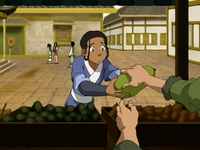
Katara purchased papaya on the recommendation of Aunt Wu, even though she loathed the fruit.

- Pear — Edible green fruit; can be purchased from fruit stands in the Lower Ring of Ba Sing Se.[95]
- Pepper — Used in soups.[84]
- Persimmon — An astringent tree fruit.[112]
- Plum[79]
- Pumpkin — Can be made into pumpkin pie.[113][114]
- Sesame[115]
- Soy — Used to make tofu.[116][36]
- Sweet potato[117]
- Tapioca — Used for bubble tea.[118][119][120]
- Taro root[88]
- Watermelon[95]
- Wild nuts[88]
- Yam[121]
Other
- Brine — Water strongly impregnated with common salt used to pickle food.[105]
- Chocolate — Used by Katara to make kale cookies.[62]
- Jennamite — A fast-growing rock candy that can be eaten as a snack. It is also known as creeping crystal.[82][122]
- Lemon juice[79]
- Maple syrup[123]
- Peanut — A small legume which can be made into a sauce. The sauce can also be used to craft certain explosives.[25]
- Salt — A mineral used as a food preservative and flavor enhancer,[9] procured from salt mines, such as the one located in the mountain neighboring Yaoping Town.[124]
- Sugar[125]
Dishes
- Bark-onion soup — Dish disliked by Baraz.[110]
- Bean curd puffs — Made in Makapu Village from cottage cheese and beans.[86][126] Sold at the Middle Ring Earthmarket in Ba Sing Se.[127]
- Beetle-worm soup — Dish prepared and served by Grandma Lokai.[128]
- Bison steak — Cooked meat from a flying bison. It is a rare dish that is consumed by citizens of the Upper Ring of Ba Sing Se.[129]
- Braised turtle duck — Sold at the Middle Ring Earthmarket in Ba Sing Se.[8][127]
- Buns
- Cabbage bun — Sold in Ba Sing Se, including by Young Crow and Merchant Cai. Eaten with warm broth inside.[130][131]
- Cookie bun — A baked pastry from Wen's Bakery sold only on the weekends. A favorite of both Jin and Suyin.[132]
- Pau buns
- Pumpkin bun — A baked pastry from Wen's Bakery.[109]
- Steamed buns[100]
- Cabbage cookies — A signature dish of the cabbage merchant in his Cabbage Delicacies Bistro.[125] One of his customers' favorite.[84]
- Cabbage noodles — A signature dish of the cabbage merchant in his Cabbage Delicacies Bistro.[125]
- Cabbage soup — A signature dish of the cabbage merchant in his Cabbage Delicacies Bistro.[125] The dish was offered to travelers who stopped into the restaurant for an early supper.[84]
- Cakes — Baked pastries enjoyed by Bosco.[133]
- Candied fruit — Fruit coated in a hard sugar shell. Sold in night markets of Ba Sing Se.[134]
- Cookie of the White Lotus — Crispy and crumbly cookies used as a prize for Pai Sho players in the Order of the White Lotus.[135]
- Crab puffs — Crab meat made into puffs.[78]
- Crab urchin stir-fry — Wild crab urchins prepared and stir-fried with cooking oil imported from the Upper Ring of Ba Sing Se. This was Jianzhu's favorite dish.[36]
- Crispy fried fish — A fish fried to a crisp. Ordered by Jin while on a date with Lee (Zuko).[136]
- Deep-fried pickled radishes — A deep-fried vegetable that Katara considered as having a pleasing aroma.[137] Sold at the Middle Ring Earthmarket in Ba Sing Se.[127]

- Dried mango[121]
- Dried sweet potato — A dried vegetable consumed by residents of the daofei settlement of Hujiang.[76]
- Dumplings — Pieces of dough wrapped around a filling of meat and/or vegetables, such as leek.[105] Types of dumplings include dao bao and xialongbao.[116]
- Dragon Dumplings — A popular dish sold by the Double Dumpling restaurant in Omashu. They are described as plump, succulent, fluffy, sweet, and fiery hot, promising an explosion of flavor. It is rumored that these dumplings may or may not contain mongoose dragon.[99]
- Dumpling weed soup[101]
- Fried cookies — Sold in Ba Sing Se markets.[109]
- Fried dough — Flour dough that is fried.[138]
- Ginger-infused pea tendril and hibiscus-root salad — An aromatic vegetarian side-dish served in gourmet meals.[90]
- Grilled sausage — Sold in Ba Sing Se markets.[109]
- Jook — Rice congee (a kind of porridge).[20][139]
- Kale wraps[106]
- Meat kebabs[140]
- Meatballs — Ground meat rolled into a ball. Ordered by Lee (Zuko) while on a date with Jin.[136]
- Misty Palms special rice — Made in the Misty Palms Oasis.[141]
- Moon peach cakes — Dessert made in Ba Sing Se from moon peaches.[127]
- Mung bean cakes — Baked in the shape of a Pai Sho tile with the image of a jasmine flower on top. Sold by Pao Family Tea House.[136]
- Noodle soup — Noodles and various vegetables and meats cooked in soup.
- Pan-fried noodles[116]
- Persimmon jam bites — A baked pastry from Wen's Bakery.[132]
- Pies — Baked pastries enjoyed by Bosco.[133]
- Pumpkin pie[113]
- Ramen — Noodle soup prepared in a variety of ways.[116]
- Roast boar — Roasted over a spit; made by the Freedom Fighters.[142]
- Roast duck — A duck that is seasoned with herbs and spices, roasted, and applied with a special sauce.[83][143][131]
- Rice balls — Sometimes willed with spicy cabbage.[144]
- Rice gruel — A meal consumed by residents of the daofei settlement of Hujiang.[76]
- Rice porridge — Commonly eaten with pickled vegetables.[145]
- Roasted chestnut — Sweet snack sold in night markets of Ba Sing Se.[134]
- Salted duck egg pastries — A Ba Sing Se delicacy from Wen's Bakery. During their occupation of Ba Sing Se, Fire Nation soldiers would be offended when trying these pastries because the filling was mixed with something savory.[146]
- Seared wild Kyoshi elephant koi — A gourmet meal prepared by pan-searing fresh elephant koi. Often served with complementary side dishes, such as hibiscus root salad.[90] Found in restaurants all over the Earth Kingdom.[147]
- Seaweed soup — A remedy for blood loss.[148]
- Seaweed wraps — Small rolls wrapped in seaweed.[91]
- Soup — Made from a variety of meats and vegetables; usually thin.
- Spicy pickled kelp — Considered a delicacy.[105]
- Stuffed apple donuts — Dessert commonly prepared and eaten during Kyoshi Day at Kyoshi Island.[94]
- Soft jelly — A dessert served from large wooden tubs and drizzled with various syrups, such as ginger.[149]
- Sugar cookies[125]
- Sun cakes — A baked pastry from Wen's Bakery with an egg yolk hidden inside.[132]
- Sushi — Small cutlets of fish rolled in rice and seaweed. It is often eaten by the inhabitants of Kyoshi Island.[138]
- Taro Swirls — A baked pastry from Wen's Bakery.[132]
- Tarts
- Chocolate mousse tart and lychee nut tart — Both became more common in Ba Sing Se later in the war, as refugees tried to establish themselves with new recipes.[109]
- Egg custard tart — A baked tart with an egg custard center.[1][131]
- Plum tart — A baked tart from Wen's Bakery with a sweet-and-sour filling surrounded by a green tea infused outer layer to make it look like a plum. The shape of the tart was Jin's idea.[150]
- Tea eggs — Used by Toph for picnics with the badgermoles. She also carried some eggs during her travels with Team Avatar.[151]
- Tiger seal rolls — Cream-filled cakes from Wen's Bakery shaped and striped like tiger seals. One of Jin's favorites.[152]
- Tofu — Tofu made into smaller puffs and fried.[116]
- Unfried dough — Regular flour dough, cut into the shape of Avatar Aang. Exclusive dish of Chin Village.[138][115]
- Vegetable wrap — A vegetarian course often served raw and made out of leafy produce, such as kale.[104]
- Wagashi desserts — Small puff pastries with various toppings and fillings. These desserts are eaten on Kyoshi Island,[88] as well as being consumed at parties in Ba Sing Se.[78]
Beverages

- Cactus juice — Named by Sokka, this liquid is consumed straight from cacti found in the Si Wong Desert and has strong hallucinogenic properties.[153]
- Earthbender mudslide — Invigorating drink.[123]
- Kale smoothie[154]
- Kalenutsco — Fresh drink made from a mixture of kale, walnuts, and coconut water, pioneered by Suyin Beifong's chef in Zaofu.[155]
- Lychee nut ice smoothie — Made in the Misty Palms Oasis.[141]
- Mango — Made from mangoes and other fruits mixed with water in an ice bowl.[107] After the war, Iroh sometimes made this drink for Katara when the team did not have time to visit the Misty Palms Oasis.[156]
- Milk — Dairy product sometimes added to tea.[118]
- Tea — Made from a variety of tea leaves in hot water.[157] Varieties include ginseng, jasmine, green, ginger, cucumber, lychee, and oolong.[20][158][159]
- Bubble tea — A popular tea in the Jasmine Dragon made with tapioca balls.[118][119][120]
- Chi-enhancing tea — A rare tea and natural stimulant known to improve an ordinary warrior's strength and energy tenfold.[160]
- Kombucha tea — A cold version of Iroh's jasmine blend.[102]
- Pearl-milk tea — Tea served with balls of softened tapioca at the bottom of the glass, pioneered by Iroh.[118]
- Wine — A beverage typically made from distilling alcohol from fruits or honey.[161][162][76]
Others
- Mint — A small piece of candy.[74]
Fire Nation

The defining characteristic of Fire Nation cuisine is its spicy nature,[163] and Fire Nation citizens are known to put spices into many of their delicacies and treats. The Fire Nation uses a wide variety of grains, meats, and vegetables in cooking.
Cooking style
As with the Earth Kingdom, many cooking methods are utilized in the Fire Nation, with an extensive variety of food types available; regional variation is smaller, however, due to the size of the nation. Boiling is used for rice and many vegetables, while fish and meats and generally steamed and roasted, respectively. Like the Earth Kingdom, baking is used extensively to make cakes, buns, and tarts, though the Fire Nation also has many snack foods, typically in the form of roasted bite-sized pieces with a large number of spices. Chili and other spices are added to nearly all savory food.
Much of the Fire Nation food is based on control and respect for firebending. Bending coals, for example, just hot enough to toast a dish but not set it alight is not just a demonstration of skill, but also a way to show appreciation and connection to their nation itself.[163]
Common ingredients
Grains
- Beans — Cooked in pots during the Festival of Szeto to represent the inventories being counted.[164]
- Flour — Made from wheat into buns and dumplings.[32]
- Millet — Toasted for use as a travel snack.[164]
- Rice — A staple food, usually boiled.[2][165]
- Sorghum[166]
- Wheat — A staple food, made into flour.[167]
Fish and meat
- Bangus fish — Usually fried.[168]
- Clam — Usually boiled.[169]
- Crab[35]
- Duck — Usually roasted.[143][170]
- Elephant rat — Eaten during survival training at the Royal Fire Academy for Girls.[87]
- Egg[171][172]
- Fish — Usually steamed with garnish applied.[173]
- Silverskim fish — A migrating fish drawn to areas of heavy rain and caught in nets.[174]
- Hippo-ox[166]
- Komodo chicken — Usually roasted. In 100 AG, Zuko took a box of komodo chicken to his uncle, Iroh, during his imprisonment in the Capital City Prison.[175][176]
- Komodo rhino — Traditionally made into sausages and served at picnics and sporting events,[67][177] but can also be made into steaks and jerky.[140][178]
- Mudfish — A fish indigenous to Lambak Island. Used in stews.[179]
- Sea slug — Usually smoked.[180]
- Shrimp — Can be used to make shrimp flakes.[181]
- Squid — Usually fried.
Fruits, vegetables, and fungi
- Apple — Grown on trees; can be bought at the market in Fire Fountain City.

- Ash banana — Brownish-yellow fruit that can be baked into a bread.[67][182]
- Banana[183]
- Cabbage — Usually boiled, stir-fried, or left uncooked and used as a garnish.[2][165]
- Cherries — Used to make ice cream in Ember Island.[184][185]
- Chili — Used extensively for almost any type of dish or served whole; found stir-fried, boiled, and in salads.[173] Eating chili helps firebenders bring out their bending talents. Nurturing the special Fire Nation chili plants is a revered practice.[163]
- Dragon paw fruit – Sweet and juicy fruit with a spiny shell.[186]
- Dumpling weed — Found in some parts of the Boiling Rock's prison complex and used by prisoners to supplement their rations.[100]
- Figs[187]
- Lychee nut — Small reddish-brown fruit that can be used to make tea or juice.[2][165]
- Lemon[180]
- Lettuce[175]
- Mango[188]
- Melon[189]
- Melonyam[190]
- Mushroom[166]
- Ocean kumquat[67]
- Onion — Used in dumplings.[32]
- Pandan[191]
- Peas[100]
- Pink berries
- Plum[166]
- Purple berries[169]
- Scallion[192]
- Star apple – Fruit with toxic skin and edible flesh.[193]
- Tamarind — A legume.[194]
- Tomato[172]
- Tomato-carrot[195]
- Wakame[196]
- Watermelon[197][198]
Other
- Brine — Water strongly impregnated with common salt used to pickle food.[177][196]
- Jelly — A semisolid substance typically made from fruit juice and sugar that can be spread on toast.[199]
- Karashi — An iconic condiment or seasoning, considered "Fire Nation mustard".[198]
- Oil[192][200]
- Salt — A mineral used as a food preservative and flavor enhancer, procured along the shore of Shuhon Island, near Fire Fountain City.[164]
- Sugar[164][163]
- Togarashi — A spice mixture.[201]
Dishes
- Bean cakes — Snack food.[202]
- Buns and bread — Can be made from flour.[85]
- Chicken skewers — The "Roku style" skewers are prepared with spicy oil and scallions.[192]
- Cookies — Snack food.[202]
- Dried mushrooms[203]
- Dumplings — Dough filled with meat and/or vegetables.
- Elephant Koi Shui Zhu Yu — Fish fillet poached in seasoned water and topped with Fire Nation spices. Prepared in the Earth Kingdom's Yokoya, this was Hei-Ran's favorite dish.[36]
- Fertilized turtle duck egg — Sometimes eaten as a snack by nobility in the Capital.[204]
- Fire cakes — A spiced pastry.[165]
- Fire gummies — Snack food.[205]
- Flaming fire flakes — Snack food; spicy flakes that are roasted.[93][96][205][206] Several variations exist.[181]
- Fried bangus fish — A dish that was part of the Lambak clan's celebratory feast to mark the autumn equinox.[168]
- Fried egg — A dish that was part of the Lambak clan's celebratory feast to mark the autumn equinox.[168]
- Fruit tart — Dessert. It can be served with rose petals on top.[8][28]
- Gruel — A breakfast item at the Fire Nation Royal Palace, typically served bland with spices and oils on the side to be added to taste.[207]
- Hippo-ox tail skewers[208]
- Hotcakes — Pastry. Sometimes used for birthday celebrations.[184]
- Ice cream — Frozen cream, eaten in waffle cones. Served in Ember Island.[173][185]
- Komodo chicken — A dish that Iroh and Zuko used to steal from the Fire Nation palace kitchen.[209]
- Komodo jerky — Jerky made from komodo rhino meat.[178]
- Komodo kabob — Popular dish with Fire Nationals.[10]
- Komodo sausage — Sausage made from komodo rhino meat.[67]
- Loco moco – Traditional dish of Hira'a.[211]
- Mochi — A chewy rice cake, may be prepared for birthday celebrations.[118]
- Mudfish stew — A dish passed down through the Lambak clan.[179]
- Noodles[2][165]
- Noodle soup — Soup with noodles and seafood.
- Udon noodles[213]
- Onsen egg[171]
- Pandan cake[191]
- Rice[2][165]
- Roast duck — Duck that is seasoned, roasted, and cut into bite-sized pieces.[143][170]
- Salted vegetables — A breakfast item at the Fire Nation Royal Palace, served alongside gruel.[207]
- Sea soup — Soup with seafood and eggs.
- Sizzle-crisps — Snack food, probably made from meat.[93] Zuko's favorite afternoon snack.[201]
- Smoked sea slug — Common dish enjoyed by middle and upper class.[180]
- Stalknose mushrooms — A traditional Festival of Szeto dish, symbolic of good harvest due to growing on overcrowded ears of grain.[208]
- Superspicy soufflé — Specialty of Kirachu Island, made with egg.[215][214]
- Tart pie — Pie with fruit tart on top.
- Tea sandwich — Small prepared sandwiches.[216]
- Toast — Sliced bread that is browned or cooked by exposure to radiant heat and can be enjoyed with condiments such as jelly.[199]
Beverages
- Azula's Lightning — A spicy, cold beverage.[217]
- Juice — A cold drink with a slice of fruit.[180]
- Plum wine – A blazing alcoholic beverage that causes a burning sensation in the throat.[166][218]
- Sorghum liquor — A strong alcoholic beverage.[166]
- Sweetened beverage — A dark, sugary drink sold during the Festival of Szeto to symbolize the prodigious amount of ink Avatar Szeto used over his career.[164]
- Tea — Made from a variety of leaves in hot water. There are many varieties. The type drunk in the homeland is Fire Nation spiced tea, mainly by commoners, but nobles may have it as well. They also enjoy jasmine and ginseng tea, roasted rice tea and tea leaf juice.[2][157][165][219][220]
- The Firebending Masters — A soothing and spicy cleansing tonic to drink before firebending practice. It was named by Iroh in honor of the Sun Warriors.[217]
- Watermelon juice — A naturally occurring beverage consumed on especially hot days or at the beach. The deep pink liquid can be drunk by cutting a hole in the top of a watermelon and sucking it out using a straw fashioned from a bamboo shoot.[197][221]
Other
- Sweet cream — Served with hotcakes.[184]
United Republic of Nations
The urban, commuter-based lifestyle of the United Republic of Nations has given rise to commercially prepared foods, such as instant noodles and snack cakes. Many citizens find it convenient to eat meals in a hurry, and have meals from workplace cafeterias, or from street food carts.[222][223] The rise of large corporations in the nation has even led to there being restaurant chains under shared franchising agreements, which compete with the traditional small, independent eateries.[224]
Most of the United Republic's gourmet cuisine are adaptations of dishes from the other nations. The cosmopolitan sense of life in the nation has led to a variety of world fusion dishes, such as traditional Earth Kingdom dishes being adjusted with Fire Nation spices.[225]
Common ingredients
- Bread — Can be made from flour.[226]
- Cherries[110]
- Chili pepper — A hot, red pepper believed by Varrick to increase brain circulation if eaten whilst hung upside down.[227]
- Eggs[228]
- Garlic[229]
- Jellynemone[230]
- Karashi — A condiment or seasoning imported from the Fire Nation. Unfamiliar to some United Republic citizens, but well-known to many home cooks.[198]
- Lemon[227]
- Lobster crab[230]
- Mint[227]
- Molasses — A viscous substance refined from sugar that can be stored in barrels and used as a sweetener.[228]
- Potatoes[95]
- Rice — A staple crop.[231]
- Sesame[231]
- Sugar[228]
- Wasabi — A spicy condiment.[229]
Dishes
- Beef jerky — Small meat snack.[232][233]
- Crispy squid balls – A famous dish served in a popular seafood restaurant.[234]
- Cupcakes — Small pastries topped with icing and cherries.[235]
- Dumplings — Usually made from flour or rice.[236][237]
- Flamey-O Instant Noodles — A convenient dish known for its quick preparation time. Shiro Shinobi advertised the product over the radio during a pro-bending match, calling them "the noodliest noodles in the United Republic".[238]
- Lobster crab chowder — The Jelly Shack's famous chowder, which secret ingredient is jellynemone.[230]
- Octopus fritters — Served as an appetizer.[98]
- Pepper jelly[229]
- Popcorn — Sold at the Pro-bending Arena.[239]
- Ramen — Noodle soup prepared in a variety of ways.[224]
- Roasted meat on sticks — When Korra and Naga arrived in Republic City and sought out food, the first place they came across was a stall selling various kebab-like snack foods, though they had no money to pay for them.[240]
- Rock crab soufflé — Considered a delicacy.[241]
- Seaweed noodles — A dish typically from the Southern Water Tribe. It is sold at Narook's Seaweed Noodlery.[2][238]
- Sesame-dried sticks — A starchy snack.[231]
- Spicy bean cakes — Supposedly enjoyed by peli-puffins.[229]
- Spicy pickled kelp — Considered a delicacy.[241]
- Strawberry pie — Pie made with strawberry filling.[242]
- Street gruel — A common meal among the homeless population of Republic City. Made from the contents of the city's various dumpsters.[243]
- Turkey duck skewers – Greasy dish.[244]
- Turtle crab noodles — A dish with turtle crab meat.[245]
- Varri-cake — A type of snack cake made and distributed by Varrick Global Industries. It contains a red filling, topped with white icing.[246]
Beverages
- Cherry-berry lemonade — A refreshing drink made from squeezed cherries, berries, lemon juice, water, and sugar.[110]
- Cucumber-aloe water — A mixture of aloe vera and water, served with two cucumber slices.[98]
- Smoothie — A drink made up of various fruits blended together.[247]
- Soda water — Carbonated water, which can also be used to remove stains from clothes.[248]
- Tea — Made from a variety of leaves in hot water.[249]
- Watermelon juice — A refreshing beverage consumed on hot days.[250]
Spirit World
Spirit World cuisine consists of a mixture of food items inspired by or found among the four nations, appearing to consist mainly of naturally occurring fruit or dishes influenced by humans who have ventured into the realm, though few spirits have shown a need or desire to eat as spirit foods do not contribute to weight gain or loss.[251]
Common ingredients
- Spirit blueberry — Small blue fruit; can be used as a topping for cake.[251]
- Spirit kiwi — Small green fruit; can be used as a topping for cake.[251]
- Spirit strawberry — Small red fruit; can be used as a topping for cake.[251]
Dishes
- Spirit cake — Baked pastry.[251]
- Spirit cupcake — Small cup-shaped cake.[251]
- Spirit icing — A sweet, viscous substance used as a coating for cake.[251]
Beverages
- Spirit tea — Made from a variety of leaves in hot water.[251]
Trivia


- Most dishes, specifically those of the Earth Kingdom and Fire Nation, are heavily influenced by real-life Asian cuisine, particularly that of China. Many of them, such as jook, roast duck, and dumplings, are real foods.
- Loco moco is based on the Hawaiian dish of the same name, in keeping with Hira'a's tropical inspiration.[211]
- The foods of the Water Tribe are heavily based on Inuit cuisine, with an emphasis on meat dishes.[41]
- While chopsticks are the primary eating utensils used worldwide,[252] utensils that resembled cutlery and forks were placed at the table during Tarrlok's Avatar gala in Republic City[235] and used in Zaofu.[90]
- The United Republic also features a more westernised style of cuisine, focusing on portability, eating on the go, and incorporation of ethnic cuisine from around the world.
- The Air Nomads are the only entirely vegetarian nation.
References
de:Gerichte in der Welt von Avatar es:Gastronomía en el Mundo Avatar fr:Cuisine dans le Monde d'Avatar pl:Kuchnia w świecie Awatara ru:Еда